Part 16: The Fading Light.
Fifteen years had passed since the day the white roses fell to the cathedral floor.
Time is a cruel and relentless thief, stealing youth, strength, and eventually, the people we love most.
I am now ninety-three years old, my body a fragile vessel holding onto the last embers of my life.
My hands, which once pulled a wounded soldier from a burning vehicle and held three terrified little girls, now tremble when I lift a coffee cup.
My vision has clouded, and my steps are slow, measured by the steady, rhythmic ticking of the grandfather clock in the hallway.
But my mind remains sharp, fiercely guarding the legacy my daughter Emily died to protect.
Sophie is twenty-seven, a formidable civil rights attorney who terrifies corrupt CEOs and defends the voiceless.
Madison is twenty-four, an art therapist whose murals cover the walls of children’s hospitals across the state.
Little Lily, who once hid behind my leg in the cemetery, is now twenty-one, a cybersecurity prodigy who consults for federal intelligence agencies.
They are brilliant, they are fierce, and they are entirely their own women.
But they are also terrified of the day I will no longer be sitting in the armchair on the porch.
The diagnosis came on a quiet Tuesday in late autumn, delivered by a young doctor who couldn’t meet my eyes.
Congestive heart failure, compounded by age and a lifetime of carrying weights too heavy for one man.
I had perhaps six months, maybe less if the winter was harsh.
I didn’t cry when he told me, because I had already shed all my tears for Emily.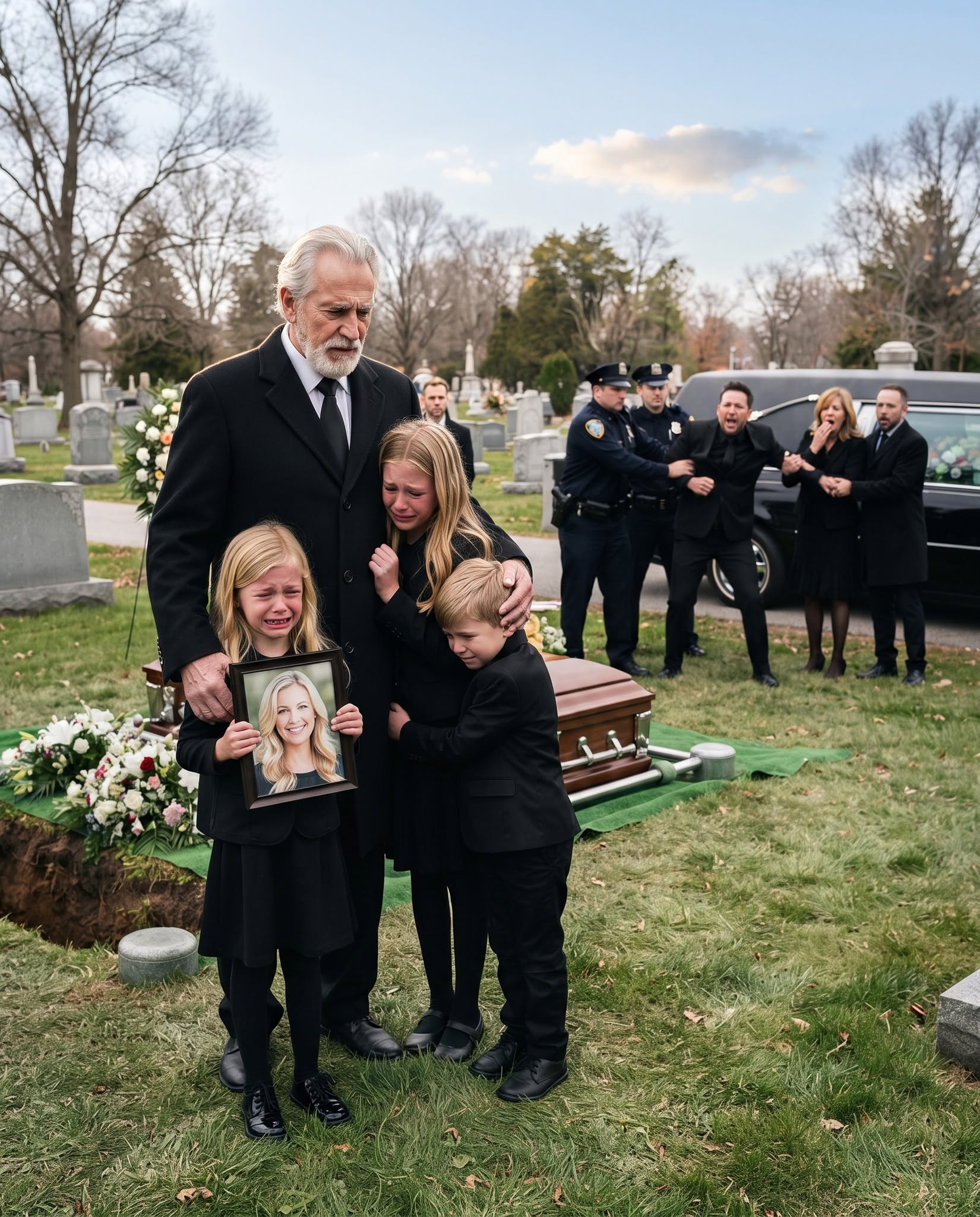
Instead, I asked him to write me a prescription for strong pain medication and sent him on his way.
That evening, I called the three of them into the living room to break the news.
I expected tears, I expected denial, I expected the same raw panic I saw in their eyes fifteen years ago.
But Sophie simply walked over, knelt beside my chair, and rested her forehead against my knee.
She told me she had already hired the best palliative care team in Savannah, and that we would manage this together.
Madison brought out her sketchbook and began drawing the view from the window, her hand shaking only slightly.
Lily sat on the floor and rested her head in my lap, just as she had when she was six years old.
We didn’t speak of death that night, we only spoke of the life we had built from the ashes of our tragedy.
But the universe, it seemed, had one final test for our family, one last ghost that needed to be laid to rest.
Part 17: The Ghost Account.
Three weeks after my diagnosis, Michael Grant arrived at the house unannounced.
He was seventy years old now, his hair completely white, walking with a slight limp from a recent knee surgery.
But his eyes still held that same sharp, predatory gleam that had put Daniel and Richard Mercer behind bars.
He carried a thick, sealed manila folder, and his face was grim.
He asked to speak with me and Sophie in the study, closing the heavy oak door behind us.
Michael sat down, placed the folder on the desk, and let out a long, heavy sigh.
He told me that the federal government had just received a tip from an dying inmate at the same supermax prison as Richard Mercer.
The inmate, a former accountant for Mercer Industries, claimed Richard had hidden a massive slush fund before his arrest.
Michael opened the folder and slid a single piece of paper across the desk.
It was a bank routing number from a shell corporation in the Cayman Islands, holding exactly five hundred million dollars.
Sophie’s eyes widened, and she leaned forward, her legal mind instantly calculating the implications.
She asked Michael why the FBI hadn’t just seized the account when they dismantled the company fifteen years ago.
Michael explained that the account was structured as an irrevocable blood-trust, requiring a biometric and digital signature from a living Mercer heir.
Richard was the primary key, but he had designated Daniel as the secondary key before he was arrested.
Richard had refused to sign the release, choosing to let the money rot rather than hand it over to the government.
And Daniel, sitting in his cell, had absolutely no idea the account even existed.
Sophie’s jaw tightened, and she asked what this had to do with us.
Michael looked at me, then at Sophie, and explained the cruelest part of the trap.
Emily’s decrypted files, the ones Sophie had broken through years ago, contained a hidden addendum.
Emily had discovered the ghost account long before she died, and she had legally tied our family’s original inheritance to it.
If the five hundred million dollars was not claimed and transferred to the girls’ charitable trust within six months, it would revert to the Mercer estate.
And since Richard and Daniel were incarcerated, the money would eventually fund the very empire they tried to use to destroy us.
The only way to stop it, the only way to claim the money and lock it away forever, was for Daniel to sign the digital release.
Sophie stood up, her face pale, and said she would rather let the money burn than ever speak to Daniel again.
I reached out and placed my trembling hand over hers, feeling the cold sweat on her skin.
I told her softly that we didn’t do this for the money, we did this to ensure the Mercer name was erased from the earth forever.
I told her that Emily had fought until her last breath to protect them, and we wouldn’t let a dying old man’s technicality undo her work.
Sophie looked at me, tears finally spilling over her lashes, and nodded slowly.
She told Michael to set up the visit, because she was going to the supermax.
Part 18: The Descent into the Abyss.
The federal supermax prison in Colorado was a concrete tomb buried in the middle of a frozen, desolate landscape.
Sophie flew out on a Tuesday, accompanied by Lily, who insisted on handling the digital transfer protocols on site.
I stayed home, confined to my bed, my heart monitor beeping a steady, fragile rhythm in the quiet room.
Madison sat by my bedside, holding my hand and reading aloud from a book she knew I wasn’t really listening to.
My mind was hundreds of miles away, walking the sterile, terrifying corridors of the prison with my granddaughter.
Sophie later told me about the journey, her voice shaking as she described the absolute desolation of the place.
She had to pass through three security checkpoints, surrender her phone, and be scanned for contraband.
The guards were heavily armed, their faces hidden behind visors, treating her like a dangerous criminal rather than a visitor.
When she finally reached the visitation room, the air was freezing and smelled of industrial bleach and despair.
She was led to a small, enclosed booth separated by a thick pane of smudged plexiglass.
There was a metal phone receiver on her side, and a digital signature pad built into the counter.
She picked up the receiver, her heart hammering against her ribs like a trapped bird.
A heavy metal door buzzed and clanked open on the other side of the glass.
Two guards escorted a man in a faded orange jumpsuit, his wrists shackled, his ankles chained.
It took Sophie a full ten seconds to recognize the broken, gray-haired man shuffling toward the chair.
Daniel Mercer, the man who had once worn custom white tuxedos and smiled while his wife was poisoned, was gone.
In his place was a hollowed-out shell of a human being, his skin sallow, his eyes sunken and devoid of light.
He was sixty years old, but he looked eighty, his body ravaged by stress, poor prison food, and the crushing weight of his own sins.
He sat down heavily, his chained hands resting on the metal counter, and picked up his receiver.
He didn’t look at Sophie, he just stared at the scratched plexiglass, his breathing ragged and shallow.
Sophie stared at him, searching for the monster who had destroyed her mother, but finding only a pathetic, dying animal.
She pressed the button to activate the microphone, her voice steady despite the ice in her veins.
Part 19: The Face-to-Face.
Sophie told Daniel that she wasn’t there to gloat, and she wasn’t there to seek forgiveness.
She told him she was there to end the Mercer legacy, once and for all.
Daniel slowly raised his head, his bloodshot eyes focusing on her face through the dirty glass.
He let out a dry, rattling cough that shook his frail shoulders, and a weak, cynical smile touched his lips.
He asked her if the old man was finally dead, his voice a raspy whisper that barely carried through the speaker.
Sophie ignored the insult, her expression completely unreadable, a perfect mask of her mother’s final days.
She explained the ghost account, the five hundred million dollars, and the legal mechanism that required his signature.
She told him that if he signed the digital pad, the money would go to the girls’ charitable trust, and the Mercer name would be legally dissolved.
Daniel’s smile faded, replaced by a look of profound confusion, and then, a sudden, dark anger.
He slammed his chained fist against the glass, the loud crack making the guards in the corner tense up.
He hissed that he would never sign it, that he would let the money rot, and that he would rather see his daughters get nothing.
He leaned closer to the glass, his eyes wild, and told her that she was just like her mother, stubborn and foolish.
He said that Emily thought she could outsmart him, and look where it got her, buried in the dirt at thirty-five.
The temperature in the room seemed to drop ten degrees, and Lily, standing a few feet behind Sophie, stepped forward.
Lily’s voice was cold and sharp as she told Daniel that his father was currently coughing up blood in the prison infirmary.
She told him that Richard Mercer had exactly three months to live, and that he was dying hating Daniel for his incompetence.
She told Daniel that if he didn’t sign the paper, the money would revert to the state, and Richard’s remaining corporate assets would be liquidated to pay for his legal appeals.
Daniel would be left with absolutely nothing, not even the bitter satisfaction of denying his daughters their inheritance.
Sophie leaned into the microphone, her voice dropping to a fierce, unyielding whisper.
She told Daniel that Emily hadn’t just left a ledger, she had left a final message specifically for him.
Daniel froze, his chest heaving, his eyes darting between Sophie and the digital pad.
Sophie pulled a folded piece of paper from her coat pocket, pressing it against the glass so he could see the handwriting.
It was Emily’s handwriting, written on the day she recorded the audio confession.
Sophie read the words aloud, her voice echoing in the small, sterile booth.
Emily wrote that she knew Daniel was a coward, a man who needed his father’s approval to feel like a king.
She wrote that she wasn’t dying for nothing, she was dying to ensure that Daniel would spend the rest of his life knowing he was a failure.
She wrote that his father despised him, his mistress betrayed him, and his daughters would forget his name.
Sophie looked Daniel dead in the eye and told him that this was his last chance to do one thing right.
She told him to sign the paper, take the five hundred million dollars out of his bloodline’s hands, and fade into obscurity.
She told him that if he refused, she would come back every year on the anniversary of her mother’s death and remind him of his failures.
Part 20: The Final Signature.
The silence in the visitation room was absolute, broken only by the hum of the fluorescent lights and Daniel’s ragged breathing.
He stared at the paper against the glass, his eyes tracing the loops and curves of his dead wife’s handwriting.
For the first time in fifteen years, the arrogant, untouchable facade of Daniel Mercer completely shattered.
His shoulders slumped, his head bowed, and a single, dirty tear tracked down his hollow cheek.
He realized, in that agonizing moment, that he had lost everything, and that his father had been right all along.
He was weak, he was foolish, and he was entirely alone.
His trembling, shackled hand reached out and pressed his thumb against the biometric scanner on the digital pad.
The machine beeped, confirming his identity, and a green light flashed on the screen.
He picked up the stylus with his other hand, his fingers shaking so violently he could barely hold it.
He signed his name, Daniel Richard Mercer, the final act of a dying dynasty.
The digital pad chimed, and Lily’s tablet instantly pinged with the confirmation of the transfer.
The five hundred million dollars was gone from the Mercer ghost account, safely locked away in the girls’ charitable trust.
Daniel dropped the stylus, slumping back in his plastic chair, looking smaller and more defeated than I could ever describe.
He didn’t say another word, he just stared at his hands, a man who had signed his own ultimate obituary.
Sophie placed the receiver back on the hook, the connection severed forever.
She stood up, adjusted her coat, and looked at him one last time through the smudged glass.
She told him that Emily forgave him, not because he deserved it, but because she was finally free of him.
She turned and walked out of the visitation room, her head held high, leaving him in the cold, concrete tomb he had built for himself.
Part 21: The Ultimate Legacy.
Sophie and Lily flew back to Savannah that same evening, arriving at the house just as the sun was setting.
I was sitting up in bed, propped up by pillows, my breathing shallow but my mind perfectly clear.
Madison was asleep in the chair beside me, her hand resting gently on my arm.
Sophie walked into the room, her eyes red but shining with a profound, triumphant peace.
She sat on the edge of the bed and took my frail hand in both of hers.
She told me it was done, that the money was secure, and that the Mercer name was officially erased from the earth.
She told me that Daniel had signed the paper, and that he looked like a ghost who was already dead.
I smiled, a slow, tired smile that reached the very bottom of my soul.
I squeezed her hand, feeling the strength and the love that flowed through her touch.
I told her that Emily was smiling down on us, that the war was finally, truly over.
That night, as the house settled into a quiet, peaceful slumber, my heart monitor began to slow.
The beeps grew further apart, the rhythm fading like a distant drum in the night.
Sophie, Madison, and Lily gathered around my bed, holding my hands, their tears falling softly onto my blankets.
I looked at each of them, memorizing their faces, storing them away in the deepest part of my heart.
I told them that they were the greatest achievement of my life, that they were the light that chased away the darkness.
I told them to live fully, to love deeply, and to never, ever let anyone make them feel small.
My vision began to blur, the edges of the room fading into a soft, warm golden light.
In that light, I thought I saw Emily, standing in the doorway, smiling her beautiful, warm smile.
She reached out her hand, and I felt a profound, overwhelming sense of peace wash over me.
My heart gave one final, gentle beat, and then I closed my eyes and stepped into the light.
Part 22: The Final Resting Place.
My funeral was held on a crisp, clear morning in late December, exactly fifteen years and two months after Emily’s burial.
There were no white lilies this time, at Madison’s request.
Instead, the church and the cemetery were filled with thousands of yellow daffodils, Emily’s favorite flower.
The pews were packed not just with family and friends, but with the hundreds of people the girls had helped over the years.
Women Sophie had defended in court, children Madison had healed through art, and students Lily had sent to college.
The air didn’t smell of decay and damp earth, it smelled of spring, of life, of renewal.
Sophie stood at the podium, her voice strong and steady, echoing across the quiet cemetery.
She didn’t speak of my age, or my illness, or the pain of losing me.
She spoke of the old soldier who had taught her how to fight, who had taught her that patience was a weapon.
She spoke of the man who had sat in the dark and listened to a twelve-year-old girl, believing her when no one else would.
Madison and Lily stood beside her, their arms linked, their faces pale but incredibly proud.
When they lowered me into the ground, they didn’t throw dirt over the casket.
Instead, they planted yellow daffodil bulbs directly over the earth, covering my resting place in the promise of spring.
Sophie placed a small, folded piece of paper on top of the casket before they sealed it.
It was the note Emily had written to me, the one I had carried in my wallet for fifteen years.
I had asked her to put it with me, so that I could give it to her mother in the next life.
The three of them stood by the grave long after the others had left, holding each other against the winter wind.
They were no longer just survivors of a tragedy, they were the architects of a beautiful, unbreakable legacy.
Part 23: The Light Remains.
Five years have passed since my burial, and the world has continued to turn.
Sophie is now thirty-two, a partner at a prestigious law firm, and she recently adopted a little girl of her own.
Madison is twenty-nine, her art studio has expanded to three cities, and she is married to a kind, gentle man.
Lily is twenty-six, running a massive cybersecurity nonprofit that protects vulnerable families from digital abuse.
And little Sophie’s daughter, my great-granddaughter, is four years old, with bright eyes and a laugh that fills the house.
They visit my grave every Sunday, bringing fresh flowers and sharing the news of their week.
They tell me about their victories, their struggles, and the beautiful, messy reality of their lives.
They know I am listening, just as I knew Emily was listening when she hid that purple velvet bag.
Daniel Mercer died in his sleep three years ago, his heart finally giving out in the cold prison infirmary.
No one claimed his body, and he was buried in the prison cemetery, his name forgotten by the world.
Richard Mercer passed away a year later, his empire dissolved, his legacy nothing more than a cautionary tale.
The Mercer family line ended not with a bang, but with a quiet, pathetic whimper in a concrete box.
But the light they tried to extinguish only burned brighter, fueled by the love of a mother and the fierce protection of a grandfather.
People like Daniel and Richard believe that power is measured in wealth, in fear, in the ability to crush those beneath you.
They believe that children are weak, that women are fragile, and that old men are easily discarded.
They mistake cruelty for strength, and they mistake silence for surrender.
But they never understand that the greatest power in the world is a mother’s love, and a father’s vow.
When you try to destroy a family, you do not just create victims, you create warriors.
You forge a lineage of survivors who will spend the rest of their lives ensuring that the darkness never returns.
Emily’s sacrifice was not in vain, her death was the seed from which an unbreakable forest grew.
And as long as the yellow daffodils bloom in the Georgia spring, her light will never, ever fade………….


One Comment on “Part 16: At my daughter’s funeral, my son-in-law pointed at his daughters and announced, “They’re going into foster care. I deserve a fresh start with my new fiancée.” More than 200 mourners stood frozen in silence”