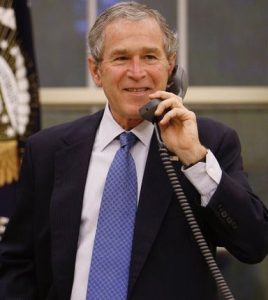
George Walker Bush, the 43rd president of the United States, remains one of the most consequential, polarizing, and widely discussed American political figures of the 21st century. His presidency was inextricably defined by the September 11, 2001, terrorist attacks, which fundamentally altered the trajectory of his administration and the course of American history. Under his leadership, the U.S. launched the Global War on Terror, initiating prolonged conflicts in Afghanistan and Iraq, while simultaneously pursuing sweeping domestic agendas, including major tax cuts, the No Child Left Behind education reform, and the creation of Medicare Part D. His tenure ultimately concluded amidst the most severe global financial crisis since the Great Depression. Born into one of America’s most prominent political dynasties, Bush forged a highly unconventional path from a struggling Texas oilman and baseball team executive to the governor of Texas, and ultimately to the Oval Office, where he served two terms from 2001 to 2009.
But his story extends far beyond the mechanics of politics. It is a profound narrative of family expectations, personal redemption, spiritual awakening, leadership during unprecedented national tragedy, controversial geopolitical decisions, and a post-presidential life that has seen him reinvent himself as an artist and a quiet elder statesman. Here is a detailed, comprehensive look at George W. Bush’s life, career, family, presidency, and enduring legacy.
### 1. Early Life, Family Dynamics, and the Shadow of Legacy
George Walker Bush was born on July 6, 1946, in New Haven, Connecticut, while his father, George H. W. Bush, was attending Yale University. He was the first child of George H. W. Bush and Barbara Pierce Bush. Although born in the Northeast, it was Texas that became the crucible for his personality and future career. In 1948, the family relocated to Midland, Texas, a rugged, oil-rich town in the Permian Basin, where his father sought his fortune in the oil business. George W. grew up in a household steeped in the values of the American West, but also under the heavy expectations of a sprawling political dynasty. His grandfather, Prescott Bush, had been a U.S. senator from Connecticut, and his father’s eventual ascent to the vice presidency and presidency cast a long, inescapable shadow over George’s youth. The Bush family experienced profound tragedy early on. George had five siblings: Jeb, Neil, Marvin, Dorothy, and Pauline Robinson, known as Robin. Robin died of leukemia in 1953 at the age of three, when George was just seven. Her death deeply traumatized the family and instilled in George a lifelong sense of empathy, as well as an early, complex confrontation with faith and mortality.
As a teenager, George was known less for academic rigor and more for his outgoing, sometimes mischievous personality, his sharp humor, and his love for sports. He attended Phillips Academy in Andover, Massachusetts, an elite prep school, before following his father to Yale University. At Yale, he studied history, graduating in 1968. He was a member of the Delta Kappa Epsilon fraternity and the secret society Skull and Bones. However, his college years were also marked by a lack of direction, heavy socializing, and academic struggles, leading him to later reflect on this period as a time of youthful indiscretion.
### 2. Military Service, Business Struggles, and Personal Redemption
After graduating from Yale in 1968, amidst the cultural upheaval and the draft of the Vietnam War era, Bush joined the Texas Air National Guard. He trained as a fighter pilot, serving from 1968 to 1973 with assignments in Texas and Alabama. He flew the F-102 Delta Dagger. Because he served in the Guard rather than deploying to Vietnam, his military record became a subject of intense political scrutiny and debate during his later presidential campaigns.
Following his military service and a stint in the Air National Guard, Bush returned to Texas and entered the volatile oil and gas industry. Unlike his father, who found success in banking and politics, George W. struggled in the business world during the 1970s and 1980s. He founded Arbusto Energy (Spanish for “bush”), which later became Spectrum 7 Energy. He experienced the harsh realities of the 1980s oil bust, facing significant financial setbacks. However, these failures taught him resilience and the harsh realities of free-market economics.
Crucially, this period of personal and professional struggle culminated in a massive personal transformation. In 1986, at the age of 40, Bush made the decision to give up alcohol completely after a conversation with the evangelist Billy Graham and a growing personal spiritual awakening. He became a born-again evangelical Christian. This decision to embrace sobriety and faith fundamentally altered his character, providing the discipline and focus that would propel his future success.
### 3. Marriage, Family Life, and the Influence of Laura
One of the most pivotal relationships in Bush’s life was his marriage to Laura Welch. The two met in July 1977 at a backyard barbecue in Midland, Texas, set up by mutual friends. Laura, a former teacher and librarian, was an avid reader with a quiet, grounded demeanor that perfectly complemented George’s boisterous energy. They married on November 5, 1977.
Laura’s influence on George was profound. Friends and biographers often note that she brought stability, intellectual curiosity, and a calming presence to his life. She is widely credited with helping him mature and focus his ambitions.
In 1981, Laura gave birth to twin daughters, Barbara Pierce and Jenna Welch. Raising the twins in Midland kept the family grounded. As George’s political career accelerated, Laura remained fiercely protective of their privacy. During his presidency, she carved out a highly respected, independent role. She championed education, literacy, and women’s rights in Afghanistan, becoming one of the most popular and trusted figures in his administration.
Today, both daughters have forged successful careers outside of electoral politics. Jenna Bush Hager is a prominent television journalist and author, while Barbara has focused on public health, education, and nonprofit leadership.
### 4. The Texas Rangers and the Launchpad to Politics
In 1989, Bush assembled a group of investors to purchase the struggling Texas Rangers baseball franchise for $86 million. Bush served as the managing general partner. This role was a masterclass in public relations and corporate management. He used his natural charm to navigate disputes among the wealthy ownership group and became a beloved figure among Texas baseball fans, known for his energetic, sometimes heckling presence in the owner’s box.
When the team was sold in 1998, Bush’s initial $606,000 investment yielded a return of nearly $15 million. More importantly, the Rangers provided him with the public visibility, name recognition, and executive experience necessary to launch a serious political career.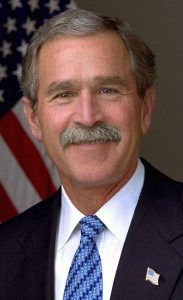
### 5. Governor of Texas: Forging a “Compassionate Conservative”
Bush’s first foray into politics was a 1978 run for the U.S. House of Representatives in Texas, which he lost to Democratic incumbent Kent Hance. He waited more than a decade to try again.
In 1994, Bush ran for Governor of Texas against the popular Democratic incumbent, Ann Richards. Running as a “compassionate conservative,” Bush campaigned on reforming welfare, improving education, and cutting taxes. He won in a Republican landslide year, becoming the first governor of Texas elected to two consecutive four-year terms (winning re-election in 1998 with a record 68% of the vote).
As governor, Bush built a reputation as a pragmatic, centrist conservative who could work across the aisle. He championed tort reform, increased state funding for education, and expanded the budget for health and human services. He also signed 152 execution warrants and oversaw the execution of 152 inmates, a record that drew intense national and international criticism but solidified his tough-on-crime credentials with the Republican base.
His successful governorship and moderate rhetoric made him the darling of the Republican Party, setting the stage for his 2000 presidential run. In a highly contested primary and a deeply flawed general election against Vice President Al Gore, Bush won the presidency following the controversial Supreme Court decision in *Bush v. Gore*, which halted the recount in Florida.
### 6. The Presidency: A Nation Transformed (2001-2009)
Bush entered office with a narrow electoral mandate and a focus on domestic policy, but his presidency was instantly and forever altered by the events of September 11, 2001.
**The War on Terror and Foreign Policy**
In the immediate aftermath of 9/11, Bush’s approval ratings skyrocketed to nearly 90%. He launched the War on Terror, invading Afghanistan in late 2001 to dismantle al-Qaeda and remove the Taliban from power.
However, his most consequential and controversial decision was the 2003 invasion of Iraq. Based on intelligence regarding weapons of mass destruction (WMDs) that later proved to be flawed, Bush argued that Saddam Hussein posed a threat to global security. The initial invasion was swift, but the subsequent occupation devolved into a brutal insurgency and sectarian civil war. The Iraq War became deeply unpopular, resulting in the loss of thousands of American and hundreds of thousands of Iraqi lives, and it severely damaged U.S. standing in the international community.
**Domestic Policy and the “Ownership Society”**
Domestically, Bush pushed an ambitious agenda. He passed massive tax cuts in 2001 and 2003. He signed the No Child Left Behind Act, a bipartisan education reform that increased federal oversight of schools. In his second term, he achieved a monumental conservative victory by passing Medicare Part D, which added prescription drug coverage to Medicare, significantly expanding the federal safety net. He also attempted to privatize Social Security and pass comprehensive immigration reform, both of which failed in Congress.
**The Financial Crisis**
Bush left office under the cloud of the 2008 global financial crisis. Triggered by the collapse of the subprime mortgage market and the failure of major financial institutions like Lehman Brothers, the crisis resulted in millions of lost jobs and foreclosures. Bush’s administration pushed through the Troubled Asset Relief Program (TARP), a $700 billion bank bailout that was highly unpopular with the public but which many economists argue prevented a total collapse of the global financial system. He left office with an approval rating of around 34%, one of the lowest in modern history.
### 7. Post-Presidency: Art, Advocacy, and a Quiet Elder Statesman
Since leaving the White House in 2009, George W. Bush has largely eschewed the daily political fray, retreating to his custom-built home in Dallas, Texas. However, his post-presidency has been highly active and surprisingly transformative.
Bush took up oil painting, a hobby he began on the advice of Winston Churchill’s writings to combat stress. He has become a prolific artist, painting portraits of world leaders, dogs, and most notably, military veterans suffering from PTSD. His book and exhibition, *Portraits of Courage*, raised millions for veterans’ charities and showcased a deeply empathetic side of the former commander-in-chief.
He also established the George W. Bush Presidential Center at SMU in Dallas, which focuses on global health, women’s empowerment, and military service.
Politically, Bush has maintained a dignified silence for the most part, but he has occasionally broken it to defend democratic institutions. In recent years, he has subtly but firmly pushed back against the populist, “America First” nationalism of the modern Republican Party, warning against isolationism, xenophobia, and the erosion of democratic norms, thereby positioning himself as a defender of the traditional, Reagan-era conservative establishment.
### 8. Legacy and Historical Assessment
George W. Bush’s legacy is a study in contrasts and the pendulum swing of historical memory. At the time he left office, he was widely criticized for the Iraq War, the handling of Hurricane Katrina, and the economic collapse.
However, as time has passed, and as the U.S. has navigated subsequent political turbulence, many historians and citizens have begun to reassess his presidency. He is increasingly viewed as a leader who, despite grave intelligence and strategic failures in Iraq, acted with deep conviction, maintained his personal integrity, and governed with a genuine desire to expand freedom and opportunity.
Ultimately, George W. Bush’s life story is a testament to the complexities of the American experience. From a wayward youth to a sober, faithful leader; from a Texas oilman to the commander-in-chief during the darkest days of the War on Terror; his journey remains one of the most fascinating and consequential chapters in modern American history.
While the public narrative of George W. Bush often focuses on his folksy Texas persona, his transformative post-9/11 leadership, and his eventual legacy as the 43rd president, the man who walked into the Oval Office in January 2001 was forged in the fires of intense personal, financial, and political struggles. Long before he was the leader of the free world, Bush was a man battling the crushing weight of his family’s legacy, his own personal demons, and a series of humiliating professional failures.
To truly understand George W. Bush, one must look behind the scenes at the profound problems he faced and the private crises he navigated in the decades before he became president. This is the untold story of his “wilderness years,” his near-ruin, and the chaotic, behind-the-scenes machinations of his rise to power.
***
### 1. The Psychological Burden of the Bush Dynasty
The most pervasive, behind-the-scenes problem George W. Bush faced before his presidency was psychological: the inescapable, suffocating shadow of the Bush family dynasty.
From the moment he was born, George was expected to be a continuation of the family enterprise. His grandfather, Prescott Bush, was a wealthy investment banker and U.S. Senator. His father, George H.W. Bush, was a WWII combat pilot, CIA Director, Vice President, and eventually President. The family motto, instilled by his mother Barbara, was a relentless drive for achievement and public service.
Behind closed doors, however, George W. struggled immensely with this expectation. Unlike his father, who was a polished, disciplined, and highly organized “organization man,” George W. was instinctual, rebellious, and academically unfocused. He suffered from what biographers often describe as a deep-seated fear of inadequacy. He watched his younger brother, Jeb, excel academically and professionally, which only heightened his own feelings of being the “black sheep” or the “disappointment” of the family.
This dynamic created a profound internal tension. George desperately wanted his father’s approval, yet he fundamentally rejected the rigid, patrician lifestyle that his father embodied. He wanted to be a Texas cowboy, not a Connecticut Yankee. This psychological tug-of-war between his desire to honor his family’s legacy and his need to carve out his own distinct, rugged identity would plague him well into his adult life.
### 2. The “Wilderness Years”: Alcohol, Aimlessness, and the 1976 DUI
Perhaps the most critical behind-the-scenes problem Bush faced in his twenties and early thirties was his struggle with alcohol and a profound lack of direction.
While his peers from Yale and Harvard were climbing the corporate ladders on Wall Street or entering prestigious law firms, Bush was drifting. He returned to Texas and took a job with the Texas Air National Guard, but his true passion seemed to be socializing. Behind the scenes, his drinking escalated from heavy partying to a genuine dependency. He was known to drink heavily during the day, alienating friends and colleagues, and his behavior became increasingly erratic.
The nadir of this period occurred on Labor Day weekend in 1976. Bush was pulled over by police near his family’s summer home in Kennebunkport, Maine. He was driving under the influence of alcohol and was arrested for a DUI.
The behind-the-scenes reality of this arrest was devastating for Bush. He was 30 years old, the son of the former CIA Director (and future President), and he had just been caught drunk driving. The humiliation was profound. He had to call his father, George H.W. Bush, who was then running for the Republican presidential nomination, to tell him the news. The campaign had to quietly manage the fallout to prevent it from becoming a major scandal.
This arrest was a massive wake-up call, but it did not result in immediate change. Bush continued to struggle with alcohol for another decade. The problem was not just the drinking; it was the underlying depression, the feeling of failure, and the terror that he was squandering his life and disgracing his family. It wasn’t until 1986, after a heartfelt conversation with his wife Laura and a pivotal meeting with Reverend Billy Graham in the White House (while his father was Vice President), that Bush finally committed to total sobriety. The behind-the-scenes battle to stay sober required immense daily discipline, a struggle that fundamentally rewired his character and gave him the spiritual grounding he would later rely on in the White House.
### 3. The Oil Bust and the Terror of Financial Ruin
Before he was a wealthy man, Bush was a struggling entrepreneur who came terrifyingly close to financial ruin. In the late 1970s and early 1980s, he entered the Texas oil and gas business, founding Arbusto Energy (later Spectrum 7 Energy).
Behind the scenes, the business was a grueling, high-stress nightmare. Bush was trying to prove he could succeed without relying on his father’s political or financial machinery. He worked 14-hour days, drilled dry holes, and watched his investors lose money. The psychological toll of being a “failed” businessman in a family of highly successful men was immense.
The ultimate problem arrived in the mid-1980s with the collapse of the global oil market. Oil prices plummeted from over $30 a barrel to under $10. The Texas economy was decimated. Bush’s company was on the verge of total bankruptcy. Behind closed doors, he was facing the very real prospect of losing everything he had worked for. He was forced to sell his company at a massive loss and merge it with another struggling entity, eventually taking a job as a consultant just to pay his mortgage.
This period of financial terror was a crucible. It stripped away his remaining youthful arrogance and taught him the harsh, unforgiving realities of the free market. It also instilled in him a deep, lifelong empathy for everyday working people who were struggling to make ends meet, a perspective that would heavily influence his “compassionate conservative” philosophy later in life.
### 4. The 1978 Congressional Defeat: A Crucial Political Humiliation
Bush’s first foray into electoral politics was a masterclass in how *not* to run a campaign, and the behind-the-scenes reality of his 1978 run for the U.S. House of Representatives in Texas’s 19th district was fraught with disaster.
Running against the Democratic incumbent, Kent Hance, Bush was heavily favored due to his family name and the Republican trend in Texas. However, behind the scenes, his campaign was a mess. He was perceived as an out-of-touch, privileged Yankee who didn’t understand rural Texas.
The most infamous behind-the-scenes problem occurred when Bush’s campaign distributed a brochure featuring a photo of him wearing a flamboyant, wide-brimmed cowboy hat and a bolo tie. The photo was intended to show he was “one of the guys,” but it backfired spectacularly. Texans saw right through it. Hance’s campaign ruthlessly mocked the photo, painting Bush as a carpetbagger playing dress-up.
Furthermore, Bush struggled with the grueling, retail-politics aspect of campaigning. He was uncomfortable shaking hands in diners and often came across as stiff or overly rehearsed. When Hance launched a fierce attack ad highlighting Bush’s voting record (or lack thereof) and his elite background, Bush’s campaign was caught off guard and failed to mount an effective counter-attack.
He lost the election by a significant margin. The behind-the-scenes fallout was severe. Bush was deeply embarrassed and felt he had let down his father, who had actively campaigned for him. However, this humiliating defeat was the most important political lesson of his life. It forced him to realize that the Bush name was not a magic ticket in Texas. He spent the next 16 years rebuilding his life, learning the retail politics of the state, and understanding the working-class voters he had previously ignored. Without the behind-the-scenes failure of 1978, the governor and president of 1994 and 2000 would never have existed.
### 5. The Ghost of 1992: Avenging His Father’s Defeat
As the 1992 presidential election approached, a new, deeply emotional problem emerged for George W. Bush: the impending defeat of his father, George H.W. Bush, by Bill Clinton.
Behind the scenes, George W. served as a key surrogate and advisor for his father’s campaign. He traveled the country, giving fiery speeches and trying to connect with voters. But the campaign was plagued by internal dysfunction, a fractured Republican party due to Ross Perot’s third-party run, and a severe economic recession.
When his father lost the election, it was a devastating blow to the family. George W. watched his father, a man of immense dignity and service, walk out of the White House, deeply embittered by the political process. For George W., this was not just a political loss; it was a profound personal injustice. He felt that the political establishment and the media had unfairly maligned his father.
This created a massive, driving problem for George W.: the need to avenge his father’s loss and restore the family’s honor. It added an intense, almost obsessive layer of motivation to his own political ambitions. When he decided to run for Governor of Texas in 1994, and later for President in 2000, he was not just running for himself; he was running to vindicate the Bush name. This emotional burden made him fiercely competitive and highly resistant to the kind of negative campaigning that had taken down his father, but it also made him highly sensitive to perceived slights from the media and political opponents.
### 6. Behind the Scenes of the 2000 Primary: Gaffes, Evangelicals, and John McCain
The road to the 2000 Republican presidential nomination was not the coronation many assumed it would be. Behind the scenes, Bush’s campaign was fraught with peril, missteps, and intense rivalries.
**The “Jeb!” Gaffe:**
Early in the campaign, Bush was struggling to connect with conservative voters in Iowa and New Hampshire. In a desperate attempt to show his conservative credentials, he attended a rally in South Carolina. When introducing his brother Jeb, who was the popular Governor of Florida, Bush mistakenly yelled, “Jeb!” instead of “Jeb!” (a play on his own name). The crowd, confused, didn’t know how to react. The media had a field day, painting Bush as a bumbling, unprepared lightweight. Behind the scenes, the campaign was in a panic, realizing the gaffe had severely damaged his momentum.
**The Struggle with the Religious Right:**
Bush’s past as a drinker and his moderate record as Governor of Texas made the conservative evangelical base deeply suspicious of him. Behind the scenes, his campaign manager, Joe Allbaugh, and advisor Karl Rove had to execute a delicate, highly choreographed strategy to win them over. Bush had to carefully signal his born-again faith without appearing to pander. He met privately with prominent pastors, answered highly specific theological questions, and slowly won their trust. It was a grueling, behind-the-scenes courtship that was essential to securing his nomination.
**The Brutal Battle with John McCain:**
The primary battle against Senator John McCain was vicious. McCain, a war hero with a reputation for straight talk, appealed to independents and moderate Republicans. Behind the scenes, the Bush campaign, guided by Karl Rove, employed aggressive tactics to neutralize him. In South Carolina, a dirty-trick campaign circulated anonymous phone calls and emails suggesting Bush had an illegitimate black child (a vile rumor that deeply upset the Bush family) and that McCain had “abandoned” his wife.
While Bush himself was not directly involved in the dirty tricks, the toxic atmosphere behind the scenes strained his relationship with McCain for years. The primary was a brutal test of Bush’s stamina and his campaign’s ruthless efficiency, ultimately proving that he was willing to do whatever it took to win.
### 7. The Vice Presidential Selection Fiasco: A Campaign on the Brink
The most chaotic behind-the-scenes crisis of Bush’s pre-presidential life occurred in the summer of 2000, during the selection of his Vice President. This episode revealed the vulnerabilities, ego clashes, and sheer panic that can occur at the highest levels of a presidential campaign.
Bush had promised to pick a “different kind of vice president”—someone who would be a true governing partner, not just a ceremonial figure. He narrowed the list down to a few finalists, including Dick Cheney, Joe Lieberman, and John Danforth.
Behind the scenes, the process was a disaster. Bush, exhausted from the grueling primary and the general election campaign against Al Gore, was deeply involved in the vetting process but was also frustrated by the endless background checks. Cheney, who was serving as the head of Bush’s VP search committee, was actually the one Bush wanted, but Cheney was highly reluctant to return to the grueling life of public service due to his severe heart conditions.
The crisis peaked in late July. Bush, believing he had finally convinced Cheney to accept the role, held a press conference in Austin, Texas. In front of the national media, Bush confidently announced, “I have selected a man to be my vice president… Governor of Texas, Rick Perry.”
Wait. It wasn’t Perry. Bush had misspoken. He quickly corrected himself, but the damage was done. The media erupted. Behind the scenes, the campaign was in absolute chaos. Karl Rove and other advisors were furious, realizing the gaffe made Bush look foolish and indecisive. Worse, Cheney, watching the broadcast, was reportedly annoyed by the public pressure and the lack of coordination.
For the next 48 hours, the campaign was in a state of high-wire panic. Cheney was still technically undecided. Bush had to fly to Wyoming to personally beg Cheney to accept the job. Behind closed doors in Cheney’s home, Bush made his final, impassioned pitch. Only after Cheney finally agreed did the campaign issue a *second*, corrected announcement.
This behind-the-scenes fiasco was a massive embarrassment. It led to a temporary cooling of the relationship between Bush and Karl Rove, and it highlighted the sheer exhaustion and friction that had built up in the campaign. Yet, Bush’s ability to swallow his pride, fly to Wyoming, and personally secure Cheney’s acceptance showed a level of determination and humility that would serve him well in the White House.
### Conclusion: The Crucible of Failure
When George W. Bush was inaugurated as the 43rd President of the United States on January 20, 2001, the public saw a confident, smiling, “compassionate conservative” who had effortlessly risen through the ranks of Texas politics.
But the man who took the oath of office was actually a survivor of his own profound personal and political failures. The problems he faced before becoming president—the crushing weight of his family’s expectations, the dark years of alcohol addiction, the terror of financial ruin in the oil patch, the humiliation of his 1978 congressional defeat, and the chaotic, behind-the-scenes crises of his 2000 campaign—were not merely obstacles. They were the crucible that forged his character.
These struggles stripped away his youthful arrogance, instilled in him a deep reliance on his faith, and taught him the harsh realities of resilience. The problems he solved in his private life gave him the psychological fortitude to handle the unimaginable problems he would soon face as President. When the Twin Towers fell on September 11, 2001, the man who stood before the nation was not the aimless drifter of the 1970s, nor the bumbling candidate of 1978. He was a man who had stared down his own personal demons, survived the brink of ruin, and learned how to navigate the most treacherous behind-the-scenes waters of American politics.